Human Oversight for Generative AI
The Generative AI Profile turns the human oversight principles in the published GOVERN 3 article into five specific actions for GAI systems.

The published GOVERN 3 article examined a basic governance question. It asked whether an organization has clearly divided responsibility between people and AI systems and whether human oversight works in practice. The Generative AI Profile takes that discussion further for systems that generate content, interact directly with users, and can appear fluent even when their output is inaccurate or harmful.
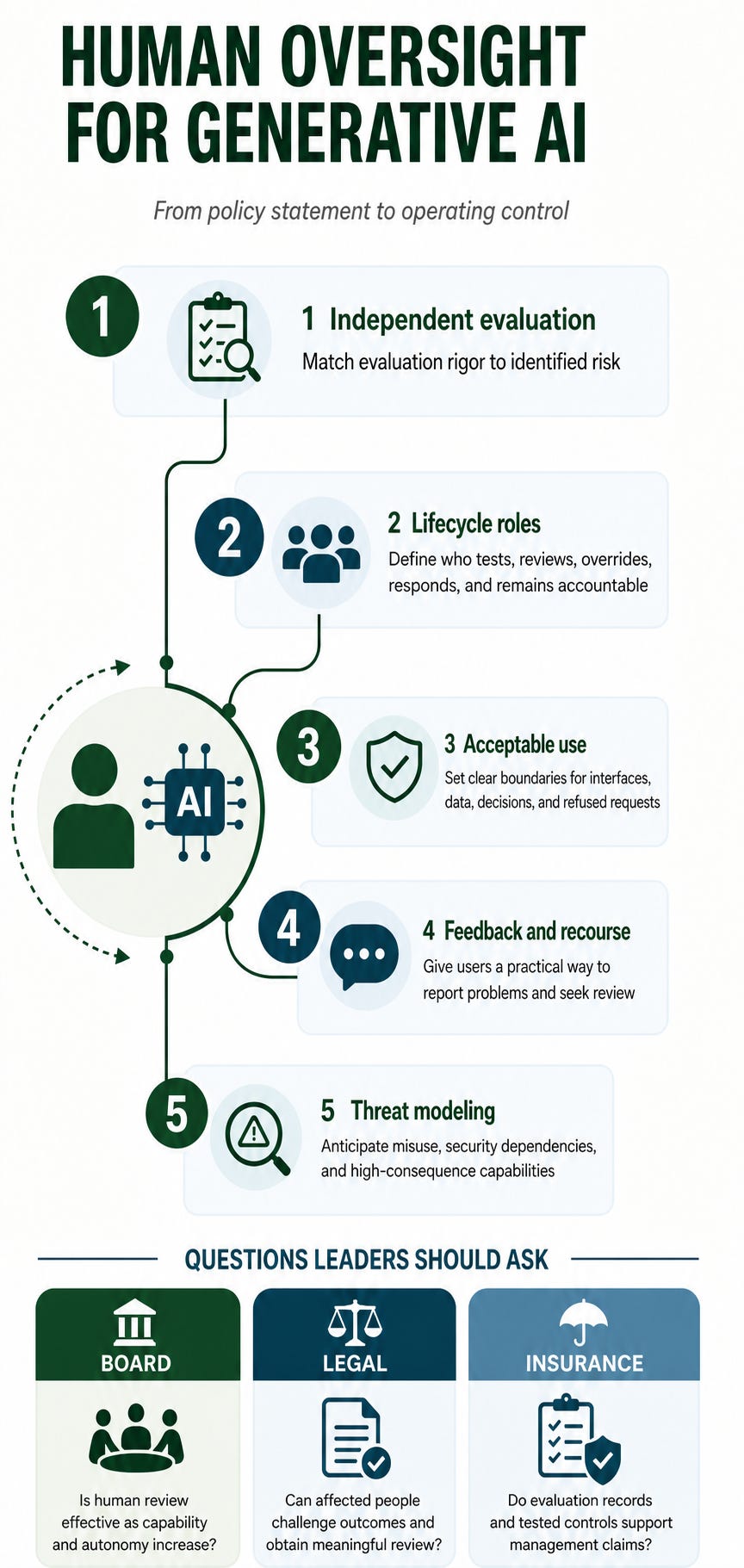
For board directors, general counsel, and insurance professionals, the comparison matters because a general promise of human review offers limited assurance. The GAI Profile adds five actions under GOVERN 3.2 that make oversight easier to test. They address independent evaluation, organizational roles, acceptable use, user feedback and recourse, and threat modeling.
Human Oversight in GAI
The earlier GOVERN 3 analysis emphasized that a person in the loop needs enough information, authority, time, competence, and organizational support to exercise judgment. Generative AI adds several pressures to that model. Output can arrive at high volume, conversational design can encourage misplaced trust, and confabulation can make an error look polished and credible. A reviewer may appear to make the final decision even when the system has already framed the issue, ranked the options, or made deviation difficult.
The five GAI actions preserve the core principle from GOVERN 3 and turn it into operating evidence. They ask organizations to show how systems are evaluated, who owns each stage of the lifecycle, which uses are acceptable, how users can challenge outcomes, and how teams anticipate misuse and failure.
GV-3.2-001 Independent evaluation proportional to risk
The first action calls for independent evaluations or assessments whose type and rigor are proportional to identified risk. A low-impact drafting assistant may require a different review from a system used in healthcare, employment, finance, public safety, or critical infrastructure. The relevant GAI risks include harmful bias and homogenization as well as chemical, biological, radiological, or nuclear information and capabilities.
This action strengthens the published GOVERN 3 discussion by moving beyond the identity of the reviewer. It asks whether the evaluation has enough independence and depth to challenge the system. Boards and counsel should expect evidence about who performed the review, what was tested, how limitations were documented, and how unresolved findings affected deployment. Insurance professionals can use the same evidence to evaluate the quality of the control environment and the credibility of management representations.
GV-3.2-002 Adjust roles across the GAI lifecycle
The second action asks organizations to reconsider roles and organizational components across the lifecycle of large or complex GAI systems. Relevant activities include testing, evaluation, validation, red teaming, content moderation, engineering, accessibility, incident response, and containment. The associated risks include human and AI configuration, information security, and harmful bias and homogenization.
The comparison with GOVERN 3 is direct. The published article asked who may act, who must review, who can override, who can stop the system, and who remains accountable. The GAI action extends those questions across the lifecycle. A role map should show ownership at each stage, the evidence required at handoffs, and the authority available when a serious issue emerges.
GV-3.2-003 Define acceptable use
The third action calls for acceptable use policies for GAI interfaces, input and output modes, and human and AI configurations. The policy should address chatbots and decision-support tasks and define the kinds of requests the application should refuse. The linked risk is human and AI configuration.
This action gives practical boundaries to the oversight model described in GOVERN 3. A policy should identify approved tasks, restricted information, required review, escalation triggers, and prohibited uses. It should also explain how the rules apply in ordinary work. A broad statement about responsible use provides little guidance when an employee faces a specific prompt, customer request, or decision deadline.
GV-3.2-004 Establish feedback and recourse
The fourth action asks organizations to create user feedback mechanisms with clear instructions and avenues for recourse. The linked risk is human and AI configuration. Feedback allows users to report errors, harmful behavior, confusing output, and access barriers. Recourse gives affected people a way to seek review or correction when an AI-supported outcome causes harm.
The published GOVERN 3 article focused on whether human oversight is real. Feedback and recourse provide evidence from the user side of that question. Leaders should be able to see who receives reports, how quickly they are reviewed, which cases are escalated, how affected people are informed, and whether recurring issues lead to changes in the system or workflow.
GV-3.2-005 Use threat modeling
The fifth action calls for threat modeling to anticipate potential risks from GAI systems. The linked risks include information security and chemical, biological, radiological, or nuclear information and capabilities. Threat modeling can examine intended users, likely adversaries, sensitive assets, system boundaries, misuse pathways, dependencies, and downstream consequences.
This action broadens human oversight from reviewing output to anticipating how a system may be misused or manipulated. The exercise should include technical and human behavior because risk often emerges from the interaction between model capability, interface design, access, incentives, and operating pressure. The result should inform testing, access controls, monitoring, incident plans, and decisions about deployment.
What the comparison reveals
The published GOVERN 3 article established the governance baseline. Human responsibility should be clear, and oversight should function as a real process. The Generative AI Profile supplies five ways to test that baseline in a GAI environment. Independent evaluation tests the quality of challenge. Lifecycle roles test ownership. Acceptable use tests boundaries. Feedback and recourse test whether users can raise problems. Threat modeling tests whether the organization looks ahead.
Together, these actions move the conversation from whether a person is involved to whether the entire oversight system is credible. For leadership and external risk stakeholders, the strongest evidence will connect written policy with evaluation results, role assignments, user reports, escalation records, and tested response plans.
Questions board directors should ask
Which GAI systems receive independent evaluation, and how is the depth of review matched to risk? Who owns testing, acceptable use, feedback, incident response, and stopping authority? Which findings have changed a deployment decision or operating restriction? How does management confirm that human review remains effective as volume, capability, and autonomy increase?
Questions general counsel should ask
Do acceptable use policies address actual interfaces, data, users, and decisions? Which requests must the system refuse, and how are exceptions handled? Can an affected person challenge an AI-supported outcome and obtain meaningful review? What records show how feedback, legal concerns, and threat findings changed controls or deployment conditions?
Questions insurance professionals should ask
Which independent assessments support the insured organization’s statements about GAI controls? Are lifecycle roles, escalation paths, and incident responsibilities clearly assigned? Does the organization track feedback and recourse outcomes? Has threat modeling addressed misuse, security dependencies, harmful bias, and high-consequence capabilities? These questions help distinguish a policy statement from an operating control.
GOVERN 3 asked whether human oversight has substance. The five actions under GOVERN 3.2 show what that substance should look like when generative AI is involved.
Source note: The NIST AI Risk Management Framework 1.0 and its Generative Artificial Intelligence Profile (NIST AI 600-1) are publicly available documents published by the National Institute of Standards and Technology. GOVERN 3.0 and the related generative AI actions discussed in this article are drawn from these publications.